Designing Multi-Agent Systems: How AI Agent Networks Power Enterprise Automation
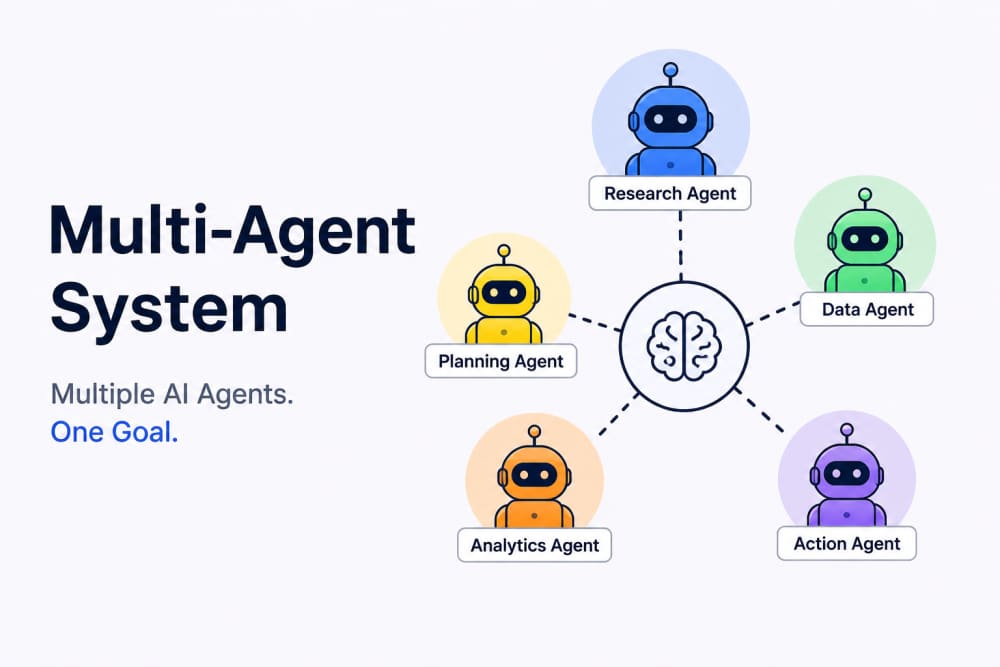
When most people imagine artificial intelligence in the workplace, they picture a single AI assistant.
Perhaps a customer support chatbot.
-A coding assistant.
-A report generator.
-A virtual employee answering questions.
At first glance, this seems like the natural evolution of AI.
One intelligent system handles everything.
However, real-world business environments are rarely that simple.
During my observations of how organizations adopt automation technologies, I have noticed a common pattern. Businesses typically start with a single AI tool to solve a specific problem. The results are often impressive. Customer inquiries are answered faster. Reports are generated automatically. Employees save time.
Then complexity arrives.
The support system suddenly needs information from billing.
The billing workflow needs compliance verification.
Compliance requires legal review.
Legal requires access to regulatory documentation.
What began as one AI assistant quickly became a network of interconnected responsibilities.
This is where Multi-Agent Systems enter the picture.
Rather than relying on one massive AI responsible for everything, organizations distribute work among multiple specialized agents, each designed to perform a specific function exceptionally well.
This approach is increasingly becoming the foundation of enterprise AI architecture.
The future of artificial intelligence is not a single super-agent.
It is teams of specialized agents collaborating safely and efficiently.
Why One Giant AI Agent Usually Fails
When organizations first experiment with AI, they often assume:
Bigger Agent = Better Results
It sounds logical.
If one AI can answer questions, surely a larger AI can handle every business process.
In practice, the opposite is often true.
A single agent responsible for:
-
Customer support
-
Finance
-
Security
-
Human resources
-
Compliance
-
Legal review
-
Technical troubleshooting
quickly becomes difficult to manage.
Several problems emerge.
Larger Context Windows
Every responsibility requires additional information.
The more responsibilities assigned to an agent, the larger its context becomes.
This increases complexity and cost.
Slower Performance
Large prompts require more processing.
Response times increase.
User experience suffers.
Increased Hallucinations
As complexity grows, the probability of incorrect reasoning increases.
The system attempts to juggle too many domains simultaneously.
Greater Security Risks
An agent with access to every system becomes an attractive target.
A compromise can affect the entire organization.
Difficult Debugging
When something goes wrong, identifying the source becomes difficult.
Was the problem in accounting logic?
Compliance logic?
Customer service logic?
The larger the system becomes, the harder it is to maintain.
This is why enterprise software architecture has long favored specialization.
The same principle now applies to AI.
The Organizational Analogy
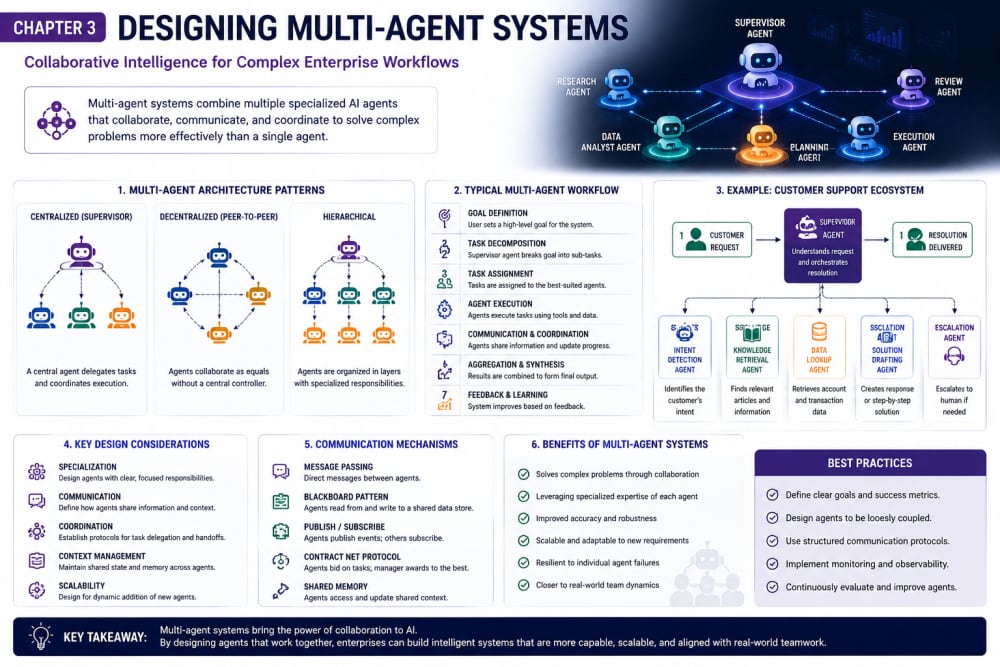
A useful way to understand multi-agent systems is to think about how companies operate.
A CEO does not personally:
-
Process payroll
-
Respond to support tickets
-
Approve every invoice
-
Conduct cybersecurity audits
-
Develop software
Organizations create departments because specialization improves efficiency.
The finance team focuses on finance.
The legal team focuses on legal matters.
The security team focuses on security.
AI systems are increasingly being designed the same way.
Instead of one massive agent, organizations deploy multiple specialized agents that collaborate toward a common goal.
A Real-World Example
Consider an e-commerce company.
A customer submits the following request:
My order arrived damaged and I would like a refund.
A traditional chatbot may respond:
Please contact customer support.
A multi-agent system can do much more.
Customer Service Agent
↓
Order Verification Agent
↓
Refund Eligibility Agent
↓
Fraud Detection Agent
↓
Approval Agent
↓
Payment Processing Agent
↓
Notification Agent
Each agent contributes a specific expertise.
The result is not just a response.
The result is a completed workflow.
This distinction is important.
The goal of enterprise AI is increasingly moving from answering questions to achieving outcomes.
Understanding Multi-Agent Architectures
Not all multi-agent systems are designed the same way.
Two architectures dominate modern enterprise deployments:
-
Hierarchical Systems
-
Peer-to-Peer Systems
Each approach offers unique advantages and trade-offs.
The Hierarchical Model
The most widely adopted approach is hierarchical orchestration.
In this architecture, a central supervisor coordinates the work of specialized agents.
Supervisor Agent
        ↓
 ┌──────┼──────┐
 ↓      ↓      ↓
Agent  Agent  Agent
 A       B      C
Think of the supervisor as a project manager.
Its responsibilities include:
-
Receiving requests
-
Assigning tasks
-
Reviewing outputs
-
Coordinating execution
-
Monitoring workflow progress
Specialized agents focus only on their area of expertise.
For example:
Supervisor Agent
↓
Finance Agent
↓
Compliance Agent
↓
Reporting Agent
This architecture is particularly attractive to enterprises because governance is easier.
Everything flows through a central coordination layer.
Advantages of Hierarchical Systems
Better Governance
Organizations maintain stronger control over decisions.
The supervisor determines what happens next.
Easier Auditing
Security and compliance teams can review centralized logs.
This is critical in regulated industries.
Improved Reliability
Specialized agents remain focused on narrow tasks.
Narrow scope usually improves performance and accuracy.
Better Cost Management
Different agents can use different AI models.
Simple tasks can use lightweight models.
Complex tasks can use advanced reasoning models.
This reduces operational expenses.
The Drawbacks of Hierarchical Systems
No architecture is perfect.
The supervisor introduces potential weaknesses.
These include:
-
Processing bottlenecks
-
Single points of failure
-
Increased latency
If the supervisor becomes overloaded, the entire workflow may slow down.
For this reason, some organizations explore a different approach.
The Peer-to-Peer Model
Instead of routing every decision through a central coordinator, peer-to-peer architectures allow agents to communicate directly.
Agent A ↔ Agent B
   ↕        ↕
Agent C ↔ Agent D
This resembles distributed computing systems.
Agents exchange information independently.
Benefits of Peer-to-Peer Collaboration
Faster Communication
Agents do not need to wait for centralized approval.
Information flows directly.
Greater Flexibility
Complex workflows emerge naturally.
The system adapts more easily to changing conditions.
Better Scalability
Removing the central bottleneck improves horizontal scaling.
The Hidden Risks
While peer-to-peer systems are powerful, they can become difficult to control.
Common challenges include:
-
Communication loops
-
Duplicate work
-
Resource waste
-
Contradictory decisions
Without proper governance, multiple agents may spend time solving the same problem repeatedly.
I have seen similar issues occur in human organizations where departments lack clear communication channels.
The same principle applies to AI systems.
Coordination matters.
What Happens When Agents Disagree?
One fascinating challenge in multi-agent systems is conflict resolution.
Imagine the following scenario:
Fraud Detection Agent
Approve transaction.
Compliance Agent
Reject transaction.
Now what?
Someone must decide.
Modern systems employ several strategies.
Voting Mechanisms
Multiple agents evaluate the same decision.
The majority opinion wins.
Example:
Agent A = Approve
Agent B = Approve
Agent C = Reject
Result:
Approve
Confidence Scoring
Agents provide confidence estimates.
Example:
Fraud Agent: 92%
Compliance Agent: 55%
The system weighs decisions accordingly.
Human Escalation
For high-risk actions, humans remain involved.
AI Recommendation
↓
Human Review
↓
Final Decision
In my opinion, this remains one of the safest enterprise approaches.
AI can accelerate analysis.
Humans provide accountability.
The Myth That Multiple Agents Eliminate Hallucinations
A surprisingly common misconception is that adding more agents automatically improves accuracy.
Unfortunately, this is not always true.
Sometimes the opposite occurs.
Imagine:
Agent A invents information.
↓
Agent B trusts Agent A.
↓
Agent C expands the mistake.
The error spreads throughout the system.
Researchers often describe this phenomenon as:
Hallucination Propagation
One incorrect assumption contaminates multiple decision layers.
Strategies for Reducing Hallucinations
Successful enterprise systems use several safeguards.
Retrieval-Augmented Generation (RAG)
Agents retrieve verified information before responding.
This reduces guessing.
Source Attribution
Claims are linked to trusted sources.
Validation Agents
Dedicated agents verify outputs before execution.
Confidence Thresholds
Low-confidence responses trigger review.
These techniques dramatically improve reliability.
The Hidden Cost Challenge: Token Explosion
One challenge that many organizations underestimate is cost.
Every AI interaction consumes computational resources.
Imagine:
10 Agents
×
10,000 Tokens Each
The expenses increase rapidly.
Poorly designed systems can become surprisingly expensive at scale.
Cost Optimization Strategies
Agent Specialization
Smaller agents require less context.
This reduces token usage.
Context Pruning
Only relevant information should be shared.
Not every agent needs the entire conversation history.
Model Selection
Not every task requires advanced reasoning models.
Smaller models often perform routine tasks effectively at a fraction of the cost.
Popular Multi-Agent Frameworks
Several frameworks currently dominate enterprise experimentation.
CrewAI
CrewAI focuses on role-based collaboration.
Ideal for:
-
Research teams
-
Content workflows
-
Internal automation
Strengths:
-
Easy to learn
-
Fast deployment
-
Strong task delegation
LangGraph
LangGraph emphasizes stateful workflows.
Ideal for:
-
Production environments
-
Long-running processes
-
Enterprise orchestration
Strengths:
-
Excellent state management
-
Complex workflow support
-
Production readiness
AutoGen
Developed by Microsoft.
Designed for agent-to-agent collaboration.
Strengths:
-
Advanced communication patterns
-
Flexible experimentation
-
Strong research capabilities
A Financial Industry Example
Imagine a modern bank processing a loan application.
A multi-agent workflow might look like this:
Customer Intake Agent
↓
Identity Verification Agent
↓
Credit Risk Agent
↓
Fraud Detection Agent
↓
Regulatory Compliance Agent
↓
Approval Agent
↓
Customer Communication Agent
Each agent performs one responsibility exceptionally well.
Benefits include:
-
Easier auditing
-
Better scalability
-
Improved maintainability
-
Stronger security
Most importantly:
The system becomes easier to trust.
My Final Thoughts
The future of enterprise AI is unlikely to be one super-intelligent agent handling every task.
Instead, it will resemble successful organizations themselves.
Teams of specialists.
Clear responsibilities.
Structured governance.
Collaborative decision-making.
The challenge facing organizations is no longer how to build intelligence.
The challenge is how to coordinate intelligence safely, efficiently, and responsibly.
Just as great companies depend on effective teams, the next generation of enterprise AI will depend on effective networks of specialized agents working together toward a common objective.
And that may ultimately become the defining architecture of the Agentic AI era.
References
About the author
Caleb Muga is the founder of SurgeTechKnow, an ICT professional and software developer with BBIT, CCNA training, cybersecurity awareness and OPSWAT file-security training. Articles are written to simplify practical technology, cybersecurity, networking and ICT support topics for real users.
Read the full SurgeTechKnow profile →

