The Evolution of Automation: From Rule-Based Scripts to Autonomous AI Agent
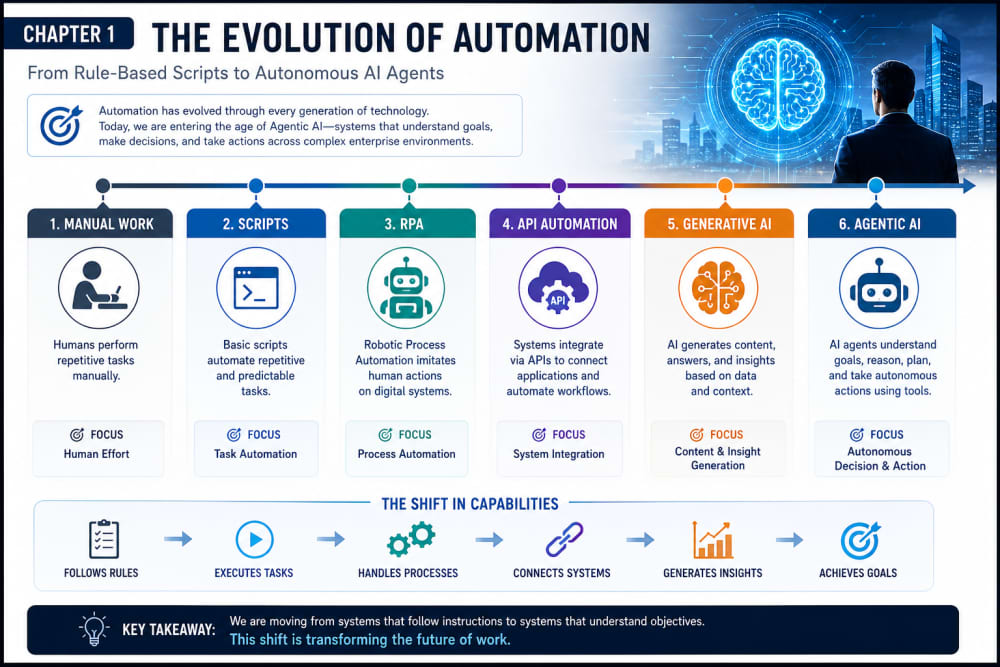
Automation has quietly become one of the most influential technologies of the modern era.
Every time you receive an automatic email confirmation, pay a bill online, receive a fraud alert from your bank, or track a package moving across the country, automation is working behind the scenes.
Most people rarely think about it.
The process simply works.
Yet beneath the surface, automation has undergone a remarkable transformation over the last three decades. What began as simple scripts designed to perform repetitive tasks has evolved into intelligent systems capable of understanding language, making decisions, interacting with software, and coordinating complex workflows with minimal human intervention.
Today, we are witnessing the rise of Agentic AI, a new generation of automation that goes beyond following instructions and begins to reason about goals.
This shift is as significant as the move from desktop software to cloud computing.
In my experience working with ICT systems and observing how organizations adopt technology, one pattern appears repeatedly: businesses initially automate simple tasks to save time, but eventually discover that the most expensive work is not repetitive. It is the work that requires interpretation, context, and decision-making.
That is exactly where modern AI agents are changing the game.
To understand why this matters, we first need to understand how automation evolved and why traditional approaches are reaching their limits.
The Early Days: When Automation Meant Scripts
Long before artificial intelligence became a household term, automation existed in a much simpler form.
Developers wrote scripts.
These scripts followed a straightforward principle:
If something happens,
perform a specific action.
A script could:
-
Rename files
-
Generate reports
-
Backup databases
-
Send email notifications
-
Transfer information between systems
For many organizations, these scripts were revolutionary.
Tasks that once consumed hours could now be completed in seconds.
A finance team could generate reports automatically.
A network administrator could schedule backups overnight.
A system administrator could monitor servers and receive alerts when problems occurred.
The beauty of these early automations was their predictability.
If the input remained consistent, the output remained consistent.
However, that stability came with a hidden assumption:
The world needed to remain predictable.
Unfortunately, business environments rarely stay that way.
When Reality Breaks Automation
One lesson technology teams quickly learn is that people do not behave like software.
Customers submit incomplete information.
Suppliers change document formats.
Employees invent shortcuts.
Regulations evolve.
Data becomes inconsistent.
Consider a simple example.
A company automates invoice processing.
The system expects every invoice to arrive in the same format.
For several months, everything worked perfectly.
Then a supplier redesigns their invoice template.
Suddenly, the automation fails.
No cyberattack occurred.
No server crashed.
The automation simply encountered something unexpected.
This highlights one of the biggest weaknesses of traditional automation:
It performs exceptionally well in controlled environments but struggles when reality becomes messy.
And reality is almost always messy.
The Rise of Robotic Process Automation (RPA)
As organizations sought to automate more complex tasks, Robotic Process Automation (RPA) emerged as a breakthrough.
Unlike traditional scripts, RPA software could imitate human actions.
Instead of integrating directly with a system, a digital worker could:
-
Open applications
-
Click buttons
-
Enter information
-
Copy and paste data
-
Navigate interfaces
In many ways, RPA behaved like a virtual employee.
This approach allowed organizations to automate processes even when APIs were unavailable.
Banks used RPA to process documents.
Insurance companies used it to handle claims.
Government agencies used it to move information between legacy systems.
The impact was significant.
According to industry research from Deloitte and Gartner, organizations implementing RPA frequently reported substantial reductions in repetitive administrative work.
Yet RPA introduced a new challenge.
It could mimic human actions.
It could not mimic human understanding.
If a button moved to a different location, the automation might fail.
If a document contained unexpected wording, the workflow might stop.
The system could follow instructions perfectly but could not interpret ambiguity.
This limitation eventually led to the next stage of evolution.
API-Based Automation: Connecting the Digital World
As cloud computing expanded, software systems became increasingly interconnected.
Instead of clicking buttons on a screen, applications began communicating directly.
This was made possible through:
-
APIs (Application Programming Interfaces)
-
Webhooks
-
Cloud integrations
-
Workflow platforms
Businesses could now create powerful automations such as:
New Customer
↓
CRM Update
↓
Email Welcome Message
↓
Create Support Ticket
↓
Notify Sales Team
These workflows were faster, cleaner, and more reliable than screen-based automation.
For many organizations, API-driven automation became the standard.
However, despite its advantages, it still relied on predefined rules.
The logic remained:
If this happens,
then do that.
And while this works beautifully for structured processes, it struggles when interpretation becomes necessary.
A customer complaint is rarely structured.
A legal document may contain nuanced language.
A cybersecurity alert may require contextual judgment.
Traditional automation sees rules.
Humans see meaning.
The gap between those two perspectives became the next frontier.
The Arrival of Generative AI
When large language models became widely accessible, automation entered a new phase.
For the first time, machines could interact with language in a way that felt remarkably human.
They could:
-
Summarize documents
-
Answer questions
-
Draft reports
-
Generate code
-
Analyze information
This represented a fundamental shift.
Instead of processing only structured data, systems could now work with unstructured information.
Emails.
PDFs.
Meeting notes.
Support tickets.
Research reports.
Customer feedback.
Information that had traditionally required human interpretation suddenly became machine-readable.
But generative AI still had a limitation.
It could explain what to do.
It could not reliably do it.
That distinction led directly to the rise of Agentic AI.
The Emergence of Agentic AI
Agentic AI represents the next chapter in automation.
Instead of merely generating text, AI agents can:
-
Understand goals
-
Create plans
-
Use tools
-
Access systems
-
Retrieve information
-
Make decisions
-
Request approvals
-
Execute actions
This changes the role of software completely.
Imagine a customer sends the following message:
I paid through mobile money yesterday, but my account still shows unpaid. Can you help? I need access urgently.
A traditional workflow may struggle.
An AI agent can:
-
Understand the request.
-
Identify it as a payment reconciliation issue.
-
Search transaction records.
-
Verify payment status.
-
Compare account information.
-
Draft a response.
-
Escalate the case if necessary.
-
Request human approval before updating records.
The system moves from following instructions to pursuing outcomes.
That is a profound difference.
Why Agentic AI Matters
The modern workplace is increasingly defined by complexity.
Organizations manage:
-
Multiple cloud platforms
-
Vast quantities of data
-
Remote teams
-
Regulatory requirements
-
Customer expectations
-
Cybersecurity threats
Many of the most valuable tasks today are not repetitive.
They are interpretive.
They require judgment.
They require context.
Agentic AI is emerging because traditional automation was never designed for that reality.
It was built for predictable environments.
Modern business is anything but predictable.

A useful analogy is:
-
RPA is a worker following a checklist.
-
Generative AI is an advisor providing recommendations.
-
Agentic AI is a trained assistant capable of completing tasks under supervision.
Understanding this distinction is critical because many organizations believe they are building AI agents when they are actually deploying chatbots with better prompts.
The difference becomes obvious in production.
One answers questions.
The other delivers outcomes.
Final Thoughts
The story of automation is really the story of software learning to handle increasing levels of complexity.
First, we automated predictable tasks.
Then we automated workflows.
Then we automated communication.
Now we are beginning to automate decision-making itself.
The future of enterprise technology will not be defined by who has the most software.
It will be defined by who has the most intelligent systems.
The organizations that succeed will not be the ones chasing hype. They will be the ones designing trustworthy, observable, secure, and human-centered AI workflows that solve real problems.
Automation is no longer about replacing clicks.
It is about augmenting judgment.
And that may be the most important shift in enterprise technology since the rise of the Internet.
References
About the author
Caleb Muga is the founder of SurgeTechKnow, an ICT professional and software developer with BBIT, CCNA training, cybersecurity awareness and OPSWAT file-security training. Articles are written to simplify practical technology, cybersecurity, networking and ICT support topics for real users.
Read the full SurgeTechKnow profile →

