Android vs iPhone: The Complete Smartphone Buying Guide
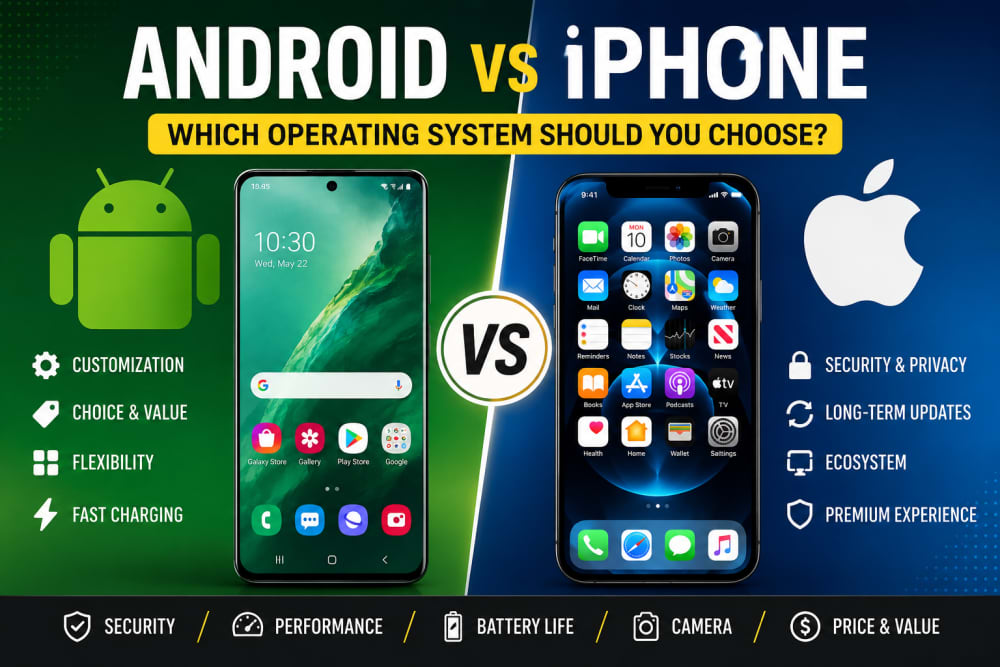
Choosing between an Android and an iPhone is not just about buying a phone.
It is about choosing an operating system, an ecosystem, a security model, an update policy, a user experience, and sometimes even a long-term financial decision.
In my experience helping users understand phones, the best choice is not always the most expensive device. The best choice is the one that fits how you live, work, communicate, spend, repair, and protect your data.
Quick Navigation
- Android vs iOS: Quick Overview
- Market Share and Local Reality
- User Experience and Ease of Use
- Customization and Control
- Security and Privacy
- Software Updates and Long-Term Support
- Apps and App Store Experience
- Performance and Hardware Optimization
- Battery Life and Charging
- Camera and Content Creation
- Ecosystem and Device Integration
- Price, Repairs, and Value for Money
- Who Should Choose Android?
- Who Should Choose iPhone?
- Final Verdict
- References
Android vs iOS: Quick Overview
Android is Google’s mobile operating system used by many phone manufacturers, including Samsung, Xiaomi, Tecno, Infinix, Oppo, Vivo, OnePlus, Google Pixel, Motorola, and others.
iOS is Apple’s mobile operating system used only on the iPhone.
This difference alone explains most of the Android vs iPhone debate.
Android gives users more variety. You can buy a budget Android phone, a mid-range phone, a gaming phone, a foldable phone, or a premium flagship.
iPhone gives users a more controlled experience. Apple designs the hardware, software, processor, ecosystem, app rules, privacy controls, and update model around one tightly managed platform.
In simple terms:
- Android is best known for choice, flexibility, variety, affordability, and customization.
- iPhone is best known for polish, long-term updates, ecosystem integration, resale value, and consistent performance.
Neither system is automatically better for everyone.
The right choice depends on what you value most.
Market Share and Local Reality
Globally, Android dominates by device numbers because it runs on thousands of phone models across different price ranges.
In Kenya, Android is especially dominant. StatCounter data for mobile operating system market share in Kenya showed Android above 92% and iOS around 6% in May 2026. You can verify the latest figures from the StatCounter mobile OS market share page for Kenya.
This matters because phone choice is not only personal. It also affects repairs, accessories, resale, charger availability, local app support, and even how easy it is to get help from friends or technicians.
In many Kenyan towns, you will find more Android accessories and repair options than iPhone-specific parts. That does not mean iPhones are bad. It means Android has a stronger local presence, especially among budget and mid-range buyers.
However, iPhones remain popular among users who want premium build quality, social media camera performance, long software support, stronger resale value, and Apple ecosystem integration.
User Experience and Ease of Use
iPhone is often easier for users who want simplicity.
Apple controls both the hardware and software, so the experience feels consistent across supported iPhones. Settings are structured familiarly, updates arrive directly from Apple, and the system generally behaves predictably.
Android can feel different depending on the brand.
A Samsung phone does not feel exactly like a Xiaomi phone. A Google Pixel does not feel exactly like an Infinix or Tecno phone. This is because manufacturers add their own interfaces, apps, settings, and features on top of Android.
This can be good or bad.
For a user who enjoys choice, Android is exciting. For someone who wants one simple experience with fewer changes between devices, the iPhone may feel easier.
From a support perspective, I have noticed that beginners often find the iPhone easier to understand at first, while Android users enjoy having more control once they become comfortable.
Customization and Control
This is one area where Android clearly has an advantage.
Android allows users to customize:
- Home screen layouts
- Default apps
- Launchers
- Widgets
- File managers
- Notification behavior
- Keyboard apps
- App installation sources
If you like making your phone feel personal, Android gives you more freedom.
You can change how your phone looks and behaves in ways that iPhone still limits.
iOS has improved customization over the years with widgets, lock screen customization, focus modes, app library, and more flexible home screen options. However, Apple still keeps stronger control over the user experience.
That control is part of Apple’s philosophy.
Apple wants the iPhone to remain clean, predictable, and less likely to break because of user-level modifications.
Android gives freedom.
iPhone gives consistency.
That is the trade-off.
Security and Privacy

Security is one of the most misunderstood areas in the Android vs iPhone debate.
Many people simply say, “iPhone is secure, and Android is not.”
That is too simplistic.
Both Android and iOS have strong security systems, but they approach security differently.
Android Security
Modern Android includes strong security features such as app sandboxing, permissions, encryption, Google Play Protect, security updates, biometric authentication, and Google Play system updates.
Google Play Protect automatically scans apps on Android devices and helps block harmful apps. Google explains this protection on the official Google Play Protect documentation page.
Google also pushes system-level improvements through Google Play services and Google system updates. You can read more from the official Google System Services Release Notes.
The challenge with Android is fragmentation.
Because many manufacturers use Android, updates do not always arrive at the same time for every device. A Google Pixel may receive updates quickly, while some budget phones may receive fewer updates or delayed patches.
iPhone Security
Apple also uses strong security protections, including app sandboxing, Face ID, Touch ID, Secure Enclave, strict App Store review, encrypted messaging through iMessage, and regular security updates.
Apple publishes security updates on its official Apple security releases page.
Apple’s biggest advantage is control.
Since Apple controls the iPhone hardware and iOS software, updates can be delivered directly to supported devices without waiting for multiple manufacturers or carriers.
Which Is More Secure?
For most everyday users, the iPhone has the stronger default security model because Apple controls the full ecosystem and limits risky behavior.
However, a well-updated Android phone from a reliable manufacturer can also be very secure.
The biggest security weakness is often not the phone.
It is the user.
Whether you use Android or iPhone, you can still be attacked through phishing, fake links, weak passwords, malicious apps, social engineering, SIM swap fraud, or unsafe public Wi-Fi.
Software Updates and Long-Term Support
Software updates are extremely important when choosing a phone.
Updates bring:
- Security fixes
- Bug fixes
- New features
- Performance improvements
- Compatibility improvements
Apple has a strong reputation for supporting iPhones for many years.
Even when older iPhones cannot receive the newest iOS version, Apple sometimes releases security updates for older systems. For example, Apple has published guidance on updates protecting older iOS versions from web-based attacks on its iOS security update support page.
Android support depends heavily on the manufacturer.
Some premium Android phones now offer long update commitments, especially from brands like Google and Samsung. Budget Android devices may receive fewer updates.
This is why two Android phones with the same Android version may not have the same long-term value.
Before buying an Android phone, check the manufacturer’s update policy.
Before buying an iPhone, check whether that model still supports the latest iOS updates.
A cheaper phone that stops receiving security updates early may become expensive in the long run.
Apps and App Store Experience

Both Android and iPhone have strong app ecosystems.
Android uses Google Play Store as the main app marketplace, while iPhone uses Apple App Store.
Most major apps exist on both platforms:
- TikTok
- YouTube
- Gmail
- Google Maps
- Microsoft Office
- Banking apps
For ordinary users, app availability is rarely a problem.
The difference is in control.
Android allows more flexibility, including installing apps from outside the Google Play Store. This can be useful for advanced users but risky for beginners.
iPhone is more restricted. Apple’s tighter App Store control reduces some risks but also limits user freedom.
If you like experimenting with apps, Android is better.
If you prefer a controlled app environment, the iPhone is better.
Performance and Hardware Optimization
iPhones are known for smooth performance because Apple designs the processor, operating system, and hardware together.
This tight integration allows iPhones to perform well even with specifications that may look smaller on paper compared to Android flagships.
Android performance varies widely.
A premium Samsung Galaxy or Google Pixel can perform extremely well. A budget Android phone may slow down faster because of weaker processors, lower RAM, slower storage, and heavier manufacturer skins.
This is where buyers need to be careful.
Do not compare Android and iPhone only by RAM numbers or megapixels.
Real performance depends on:
- Processor quality
- Storage speed
- Software optimization
- Update support
- Thermal management
- Background app control
If you are buying a budget phone, Android gives you options.
If you want long-term smoothness with less technical decision-making, the iPhone is often safer.
Battery Life and Charging
Android phones often offer more charging variety.
Some Android devices support very fast charging, large batteries, reverse wireless charging, and battery optimization tools.
In markets where electricity and daily mobility matter, this can be important.
A phone that charges quickly can be useful for students, boda riders, business owners, field workers, and anyone who moves around a lot.
iPhones generally focus on battery efficiency, battery health management, and balanced charging rather than extreme charging speeds.
Apple’s battery experience is usually reliable, but fast charging on many Android phones is ahead.
However, battery quality depends on the specific model.
A cheap Android phone with a large battery is not automatically better than an iPhone with a smaller battery.
Look at real-world reviews, charging speed, battery health features, and software optimization.
Camera and Content Creation
Camera quality is one of the biggest buying factors today.
iPhones are especially strong in video recording, social media consistency, color balance, and app optimization.
This is why many content creators prefer the iPhone.
When uploading videos to social platforms, iPhone footage often looks more consistent because many apps are well optimized for Apple devices.
Android has improved massively.
Premium Android phones from Samsung, Google, Xiaomi, and others can produce excellent photos and videos. Some Android phones offer better zoom, more manual controls, higher megapixel sensors, and advanced camera modes.
If you want simple point-and-shoot reliability, the iPhone is excellent.
If you enjoy camera flexibility, zoom, pro modes, and experimenting, premium Android devices can be better.
For budget buyers, Android gives many camera options, but quality varies greatly.
Ecosystem and Device Integration
This is where the iPhone becomes very strong.
If you already use:
- MacBook
- iPad
- Apple Watch
- AirPods
- iCloud
Then iPhone makes a lot of sense.
Apple devices work together smoothly.
You can copy on iPhone and paste on Mac. You can answer calls on an iPad. You can unlock a Mac with Apple Watch. AirPods switch between devices easily.
This ecosystem experience is one of Apple’s biggest strengths.
Android also has ecosystems, especially with Samsung, Google, and Windows integration.
Samsung phones work well with Galaxy Watch, Galaxy Buds, tablets, and Windows PCs. Google Pixel phones integrate strongly with Google services.
However, Apple’s ecosystem still feels more unified for many users.
If your digital life is already built around Apple, leaving iPhone may be difficult.
If your digital life is built around Google, Windows, WhatsApp, Gmail, and flexible devices, Android may feel more natural.
Price, Repairs, and Value for Money
This may be the most practical section for many buyers.
Android exists at almost every price point.
You can buy:
- Entry-level Android phones
- Mid-range Android phones
- Premium Android flagships
- Foldable Android phones
- Gaming Android phones
iPhones are generally more expensive upfront.
However, iPhones often retain resale value better than many Android phones.
So the real cost depends on how long you keep the device.
If you buy a phone for one or two years and resell it, the iPhone may recover more value.
If you want the cheapest phone that can handle WhatsApp, calls, browsing, photos, and mobile money, Android is the practical choice.
Repairs also matter.
In many local markets, Android repairs may be cheaper and easier depending on the brand. iPhone repairs can be more expensive, especially for screens, batteries, Face ID components, and original parts.
Before buying, ask yourself:
- Can I afford repair costs?
- Are spare parts available locally?
- Will I keep the phone for many years?
- Do I care about resale value?
- Do I need premium performance or basic reliability?
Who Should Choose Android?
You should choose Android if you want flexibility, variety, and better control over your budget.
Android is the better choice if:
- You want many price options.
- You prefer customization.
- You want fast charging options.
- You use Google services heavily.
- You want expandable features depending on the model.
- You want more freedom with files and apps.
- You want easier access to local repair options.
- You are buying on a limited budget.
Android is also excellent for learners and ICT enthusiasts because it exposes users to more settings, file systems, app permissions, developer options, network tools, and customization possibilities.
If you enjoy understanding how technology works, Android gives you room to explore.
Who Should Choose an iPhone?

You should choose an iPhone if you want consistency, long-term support, premium build quality, strong video performance, and ecosystem integration.
iPhone is the better choice if:
- You already use Apple devices.
- You want long software support.
- You prefer a simple and polished user experience.
- You create a lot of social media content.
- You value resale value.
- You want strong default privacy controls.
- You prefer fewer technical decisions.
- You want reliable performance over several years.
iPhone is especially good for users who do not want to compare many models, skins, processors, update policies, and software differences.
Apple reduces choice, but also reduces confusion.
Final Verdict
The Android vs iPhone debate does not have one universal winner.
Android wins on variety, affordability, customization, charging options, and flexibility.
iPhone wins on ecosystem integration, long-term software consistency, video performance, resale value, and polished user experience.
If you are budget-conscious, want flexibility, and prefer a phone that adapts to your needs, Android is likely the better choice.
If you want a premium experience, long update support, strong resale value, and smooth integration with other Apple devices, the iPhone is likely the better choice.
In my view, the smartest buyer is not the one who blindly defends Android or iPhone.
The smartest buyer is the one who understands their own needs.
Before buying, ask:
- What is my budget?
- How long will I keep this phone?
- Do I care about updates?
- Do I need strong camera performance?
- Can I afford repairs?
- Do I prefer freedom or simplicity?
- Which ecosystem do I already use?
Answer those honestly, and the right choice becomes much clearer.
References
- Android Official: Android 16 Features
- Google Blog: Android 15 Features and Security Updates
- Google Play Protect Documentation
- Google System Services Release Notes
- Apple Security Releases
- Apple iOS Security Update Guidance
- Apple iOS Official Page
- StatCounter: Mobile OS Market Share in Kenya
About the author
Caleb Muga is the founder of SurgeTechKnow, an ICT professional and software developer with BBIT, CCNA training, cybersecurity awareness and OPSWAT file-security training. Articles are written to simplify practical technology, cybersecurity, networking and ICT support topics for real users.
Read the full SurgeTechKnow profile →

