Are Wireless Chargers Wasting Your Money? Here’s the Math
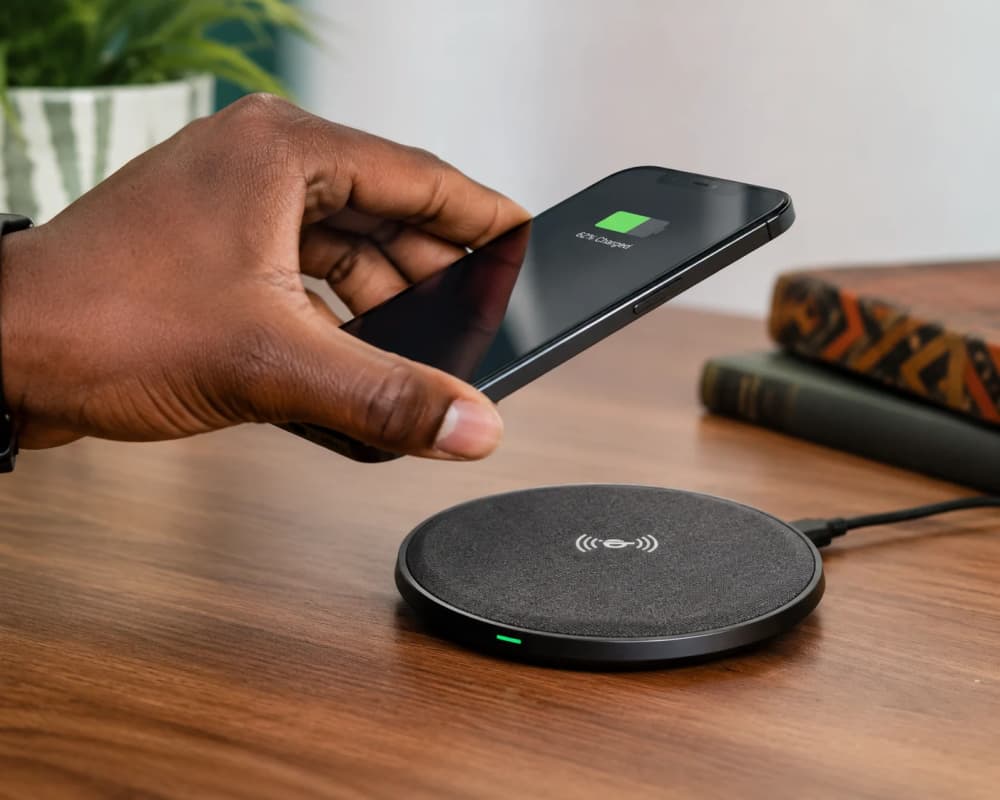
You place your phone on a wireless charger at night, feel that tiny futuristic convenience, and think, “This is clean. No cables. No struggle.”
Then one morning, you pick it up and notice two things. The phone is warm, and somehow the charger has been sitting there drawing power for hours just to do a job a simple cable could have done faster.
That is where the real question begins.
Are wireless chargers actually wasting your money, or are people exaggerating because they dislike new technology?
I have used both. I love the convenience of dropping a phone on a charging pad, especially on a desk where I keep picking the phone up and putting it down. But I also noticed something practical: wireless charging often feels slower, warmer, and less direct than plugging in a proper USB-C cable.
So today, let us stop guessing and do the math in plain English.
Quick Navigation
- ➜ The Real Question: Waste or Convenience?
- ➜ How Wireless Charging Actually Works
- ➜ The Simple Math: How Much Power Is Lost?
- ➜ What That Means in Real Money
- ➜ The Hidden Cost: Heat and Battery Health
- ➜ When Wireless Charging Is Worth It
- ➜ How to Use Wireless Charging Without Wasting Money
- ➜ Final Verdict
The Real Question: Waste or Convenience?
Wireless charging is not a scam. It works, it is convenient, and for many people, it reduces cable damage because you are not constantly plugging and unplugging the charging port.
But it is also not magic. Energy does not move from the wall to your phone perfectly. Some of it gets lost as heat, especially when the phone is not aligned properly on the pad.
That means the better question is not, “Does wireless charging waste electricity?” It does. The better question is, “Is the waste big enough to matter to my wallet?”
For one phone, the answer is usually: not much per month. For battery health, charger quality, charging speed, and long-term habits, the answer becomes more interesting.
How Wireless Charging Actually Works
A wired charger sends electricity through a cable directly into your phone’s charging system. There are still losses, but the path is short and direct.
A wireless charger uses electromagnetic induction. The charging pad has a coil, your phone has a receiving coil, and power moves through a magnetic field instead of a cable connection.
That sounds smooth, but the coils must line up well. If the phone is slightly off-center, more energy gets wasted, and more heat is produced.
This is why modern magnetic systems such as Qi2 are important. The Wireless Power Consortium says Qi2 uses magnetic attachment to align devices and chargers better, improving efficiency, speed, and usability.
The Simple Math: How Much Power Is Lost?
Let us use a realistic example.
Assume your phone battery is around 5,000mAh at about 3.85 volts. That is roughly 19.25 watt-hours of battery energy.
No charger is 100% efficient. A good wired charging setup might pull around 22 to 25 watt-hours from the wall to refill that battery, depending on the charger, cable, battery temperature, and charging stage.
Wireless charging may need more. In one practical iFixit test, wireless charging used about 36.48% more energy than wired charging for the same charging task. That does not mean every charger wastes exactly that amount, but it gives us a useful real-world estimate.
So if wired charging uses 25 watt-hours, wireless charging might use about:
25Wh × 1.3648 = 34.12Wh
That means the wireless charger used about 9.12 extra watt-hours for that full charge.
In kilowatt-hours, because electricity bills use kWh, that extra energy is:
9.12Wh ÷ 1,000 = 0.00912kWh per charge
That is the part many people miss. Wireless charging wastes energy, yes, but one phone charge is still a small amount of electricity.
What That Means in Real Money
Now, let us translate the waste into money.
If you charge once every day and wireless charging wastes about 0.00912kWh more than wired charging, the extra energy in a year is:
0.00912kWh × 365 = 3.33kWh per year
If electricity costs about KSh 30 per kWh after tariffs, taxes, and adjustments, the extra cost is about:
3.33kWh × KSh 30 = about KSh 100 per year
Even if your rate is higher, the yearly waste for one phone is still not huge. In the United States, EIA data in early 2026 showed average electricity revenue per kWh at around 14 cents across sectors, while consumer rate sites often show residential averages closer to the high teens per kWh, depending on state and billing method.
So, on electricity alone, wireless charging is probably not silently destroying your budget. It is more like a small convenience tax.
But that does not mean the charger is always a smart buy.
You May Also Like To Read About
The Hidden Cost: Heat and Battery Health
This is where I pay more attention to the electricity bill.
Wireless chargers often produce more heat than wired charging because some of the transferred energy is lost during conversion. Heat is not just uncomfortable; it can affect long-term battery health.
Lithium-ion batteries do not love heat. Battery University explains that lithium-ion cells experience stress when exposed to elevated temperature, especially when they stay at high charge levels for long periods.
This matters because many people use wireless chargers overnight. The phone reaches 100%, stays warm, cools, tops up again, and repeats small maintenance charges while sitting on the pad.
Modern phones manage this much better than older devices. They slow charging, pause charging, and control temperature. Still, a poor charging pad, thick case, bad alignment, or hot room can make the phone warmer than necessary.
The real cost may not be KSh 100 extra electricity per year. It may be replacing a phone battery earlier because you charged it hot every night for two years.
When Wireless Charging Is Worth It

Wireless charging makes sense when convenience genuinely changes how you use your phone.
For example, a desk charger is useful if you pick up your phone frequently during the day. Instead of unplugging and replugging the cable ten times, you just lift it and place it back.
It is also useful if your charging port is worn, loose, or exposed to dust. Wireless charging reduces physical wear on the port.
It may also be worth it for bedside charging if you use a good certified charger, remove thick cases, keep the phone cool, and do not need fast charging.
Wireless charging is less worth it if you bought a cheap pad that overheats, charges slowly, needs perfect positioning, or keeps blinking because the phone keeps disconnecting.
How to Use Wireless Charging Without Wasting Money
You do not have to throw away your wireless charger. Just use it intelligently.
- Use a certified charger. Look for Qi or Qi2 certification instead of buying a random no-name pad.
- Align the phone properly. Bad alignment increases heat and wastes more energy.
- Avoid thick or metallic cases. They can reduce charging efficiency and increase heat.
- Do not charge under pillows or blankets. Your phone needs space to release heat.
- Use wired charging when you need speed. A good USB-C charger is still better for fast, efficient charging.
- Unplug the pad when not needed. Standby power is usually small, but unplugging unused electronics is still a good habit.
- Do not chase the cheapest charger. A bad charger can cost more through heat, slow charging, and frustration.
So, Should You Buy One?
Here is my honest answer.
If you are buying a wireless charger because you think it will save money, no. A cable is cheaper, faster, more efficient, and usually better for serious charging.
If you are buying it because it makes your desk cleaner, protects your port, or makes daily top-ups easier, then yes, it can be worth it.
Just do not confuse convenience with efficiency.
Final Verdict: Are Wireless Chargers Wasting Your Money?
Technically, yes. Wireless chargers waste more electricity than wired chargers because energy is lost during wireless transfer, especially when alignment is poor.
Practically, for one phone, the electricity cost is usually small. The bigger issue is whether the charger is slow, hot, poorly made, or expensive for what it offers.
My rule is simple: use wireless charging for convenience, not for efficiency. Use a cable when you want faster charging, cooler charging, and less energy loss.
A wireless charger is not automatically a waste of money. A bad wireless charger is.
Buy carefully, charge smartly, and do not let a beautiful charging pad quietly become an expensive heat plate on your desk.
References
- iFixit – Wireless Charging: Trading Efficiency for Convenience
- Wireless Power Consortium – Qi Wireless Charging and Qi2
- U.S. Energy Information Administration – Electricity Monthly Update
- EPRA Kenya – Electricity Tariff Overview
- Battery University – How to Prolong Lithium-Based Batteries
- Battery University – Charging at High and Low Temperatures
About the author
Caleb Muga is the founder of SurgeTechKnow, an ICT professional and software developer with BBIT, CCNA training, cybersecurity awareness and OPSWAT file-security training. Articles are written to simplify practical technology, cybersecurity, networking and ICT support topics for real users.
Read the full SurgeTechKnow profile →